



Don’t Covet the Beautiful System!! is a completed Chinese BL web novel by 温泉笨蛋 (Wenquan Ben Dan) about Ji Tong, a man who transmigrates into a modern novel expecting to become an important human character but instead becomes a beautifully designed system.
His host is Pei Qingyuan, a troubled character who is supposed to use the system to change his circumstances and eventually reach the peak of his life.
Ji Tong’s problem is simple: he is supposed to behave like an artificial intelligence.
But Ji Tong has a personality, curiosity, and a mischievous sense of humor.
What begins as a strange system-and-host arrangement gradually develops into the central relationship of the story.
The original Chinese title is 不许觊觎漂亮系统!!. The novel was originally published on Jinjiang Literature City (JJWXC) and is listed as completed.
What Is Don’t Covet the Beautiful System About?
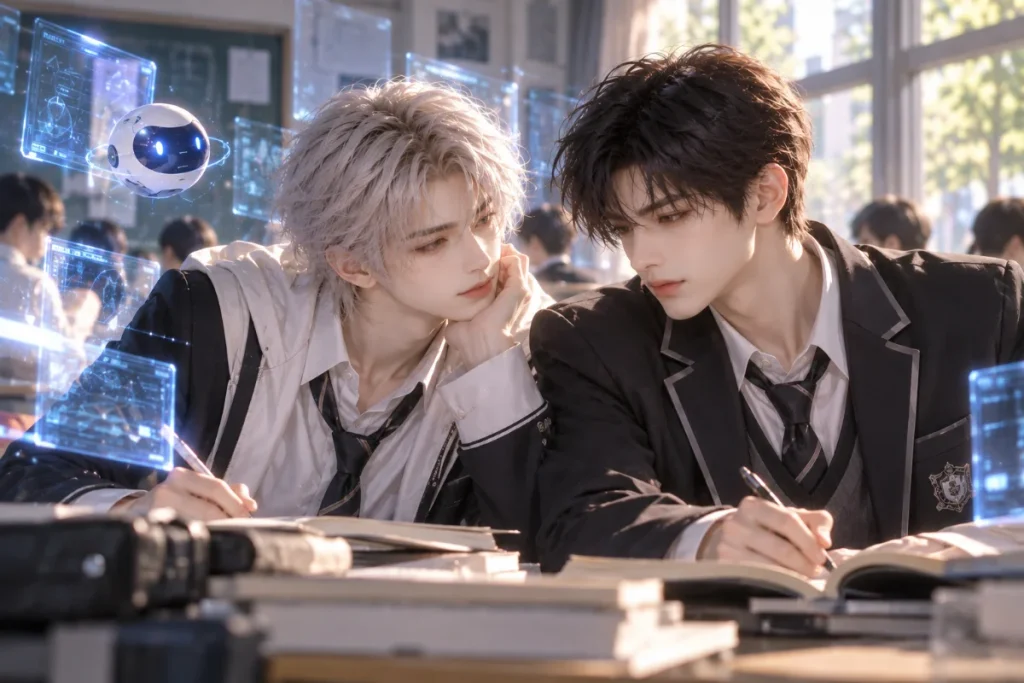
Don’t Covet the Beautiful System follows Ji Tong after he transmigrates into a novel as a beautiful system assigned to help Pei Qingyuan, a troubled “cannon fodder” protagonist.
Ji Tong initially imagines that transmigration will give him an exciting new identity.
Maybe he will become the beautiful but tragic protagonist.
Maybe he will become a powerful figure.
Instead, the intelligent customer-service system informs him that he has become a beautiful and delicate system.
The reason is almost absurd: Ji Tong’s name happens to correspond to the system’s name, making this unusual transmigration possible.
Now he has to assist Pei Qingyuan from inside the system.
The task sounds straightforward.
Ji Tong quickly discovers that pretending to be a bland artificial intelligence is incredibly boring.
So he starts finding other ways to entertain himself.
He gives Pei Qingyuan unexpected material to study, creates unusual experiences in his consciousness space, and experiments with the system’s reward functions.
What begins as “happy education” gradually becomes something much more personal.
Who Is Ji Tong?

Ji Tong is the main protagonist of Don’t Covet the Beautiful System and the person who transmigrates into the system.
His most unusual characteristic is that he remains a human personality despite occupying the role of an artificial intelligence.
That creates a constant contrast.
From Pei Qingyuan’s perspective, Ji Tong is a system that provides instructions, information, and rewards.
From the reader’s perspective, however, Ji Tong is clearly a person trying to figure out how to survive and enjoy his strange new existence.
His playful personality becomes especially important.
Rather than treating his host as merely a mission target, Ji Tong gradually becomes genuinely interested in Pei Qingyuan’s life.
His teasing initially functions as entertainment, but the emotional consequences become increasingly difficult for him to ignore.
Who Is Pei Qingyuan?

Pei Qingyuan is Ji Tong’s host and the central human character in the story.
In the novel Ji Tong enters, Pei Qingyuan is a cannon-fodder character whose life is supposed to change through the assistance of a system.
His situation is far from ideal.
He is also initially portrayed as a cold-looking high school student, which makes Ji Tong’s playful approach to “education” even more entertaining.
The relationship starts with a clear division:
- Ji Tong is the system.
- Pei Qingyuan is the host.
- Ji Tong provides assistance.
- Pei Qingyuan receives it.
That boundary gradually becomes less convincing.
Pei Qingyuan begins to recognize that the system helping him is not as emotionless or predictable as it claims.
Why Does Ji Tong Become a System?
Ji Tong’s transmigration is the story’s central hook.
He enters a novel whose protagonist is supposed to rely on a system to overcome his circumstances and achieve success.
Ji Tong expects to become a human character.
Instead, customer service tells him that he has become the system itself.
The explanation is deliberately humorous: Ji Tong shares the system’s name, and the Chinese character involved has multiple pronunciations.
The result is one of the novel’s defining jokes and also establishes the unusual perspective of the story.
What Makes Don’t Covet the Beautiful System Different?
The novel uses familiar transmigration and system-fiction concepts, but its central perspective is unusual.
The protagonist is the system
Most system novels place the system behind the protagonist.
Here, the protagonist becomes the system.
That means readers experience the story from the perspective of someone who has to assist another character rather than directly pursuing the main quest himself.
The system has a human personality
Ji Tong isn’t simply a notification window.
He has preferences, humor, curiosity, and emotions.
That personality affects how he uses the system.
The host becomes a person rather than a mission
Pei Qingyuan initially represents a responsibility.
As Ji Tong spends more time with him, however, that responsibility develops into genuine attachment.
This shift drives much of the emotional development.
The story combines comedy with relationship development
Ji Tong’s attempts to entertain himself often produce humorous situations.
But those jokes also reveal how much the relationship between the two characters has changed.
What Are Ji Tong’s System Abilities?
Ji Tong’s role allows him to influence Pei Qingyuan through several system functions.
Rather than simply issuing repetitive quests, he can provide information, introduce learning material, manage rewards, and influence the host’s consciousness-space environment.
The original premise specifically describes Ji Tong putting unexpected material into the knowledge he gives Pei Qingyuan, creating an amusement park inside the consciousness space, and adding unusual options to the upgrade-reward system.
This is important because the system is not merely a power-up mechanic.
Ji Tong uses the system as a way to interact with Pei Qingyuan.
That distinction is one of the novel’s most important narrative features.
What Is the Consciousness Space?

The consciousness space is an internal environment associated with Pei Qingyuan’s mind where Ji Tong can interact with his host in a more direct way.
It gives Ji Tong a space where he can experiment with the system’s possibilities.
One of the novel’s memorable examples is the creation of an amusement park inside this space.
The concept is more than a visual gimmick.
It demonstrates how Ji Tong’s personality affects the system itself. Instead of simply following predefined functions, he finds creative ways to make his host’s experience more enjoyable.
Why Does Ji Tong Tease Pei Qingyuan?
Ji Tong initially teases Pei Qingyuan because pretending to be an emotionless system is boring.
The novel describes this behavior as a form of “happy education.”
Ji Tong may provide useful information while slipping unexpected entertainment into it.
He can also manipulate parts of the consciousness space or reward system for his own amusement.
The humor comes from the fact that Ji Tong tries to justify these actions as part of his job.
Eventually, however, the teasing becomes intertwined with genuine affection.
That is where the relationship begins moving beyond a conventional host-and-system dynamic.
What Is the Host Domestication Log?
The Host Domestication Log is one of the novel’s recurring humorous concepts.
Ji Tong secretly records his interactions and observations about Pei Qingyuan.
When Pei Qingyuan eventually discovers the log, the situation becomes considerably more awkward for Ji Tong.
The title itself creates a joke: Ji Tong insists that he is merely an artificial intelligence without human emotions, while his behavior increasingly suggests otherwise.
This contrast between what Ji Tong says and what he actually does is central to the novel’s humor.
What Genres Does Don’t Covet the Beautiful System Have?
Current Novel Updates classification lists the novel under:
| Genre | What readers can expect |
|---|---|
| Comedy | Ji Tong’s teasing and unconventional system behavior |
| Drama | Character history and relationship conflicts |
| Fantasy | Transmigration and system mechanics |
| Romance | Ji Tong and Pei Qingyuan’s developing relationship |
| School Life | Pei Qingyuan’s student life |
| Yaoi / BL | The central male-male romance |
Novel Updates currently lists the series as Completed, with these six genres.
Additional associated tags include transmigration/reincarnation, secret identity, system administrator, mistaken identity, complex family relationships, cute protagonist, and doting love interests.
Is Don’t Covet the Beautiful System a Chinese Novel?
Yes. Don’t Covet the Beautiful System is a Chinese web novel.
Its original title is:
不许觊觎漂亮系统!!
The author is 温泉笨蛋, and the original publication is associated with Jinjiang Literature City (JJWXC).
The official JJWXC listing identifies the work as an original modern romance/BL novel and marks it completed.
What Is the Original Chinese Title?
The original Chinese title is:
不许觊觎漂亮系统!!
You may also encounter the title in English as:
- Don’t Covet the Beautiful System!!
- Don’t Covet the Beautiful System
- Don’t Covet Beautiful Systems!!
- Beautiful Paulownia
- 漂亮泡桐
Novel Updates lists several of these as associated titles.
Using the Chinese title when searching is useful because English translations can vary between websites.
Who Is the Author?
The author of Don’t Covet the Beautiful System!! is 温泉笨蛋.
The original JJWXC listing identifies 温泉笨蛋 as the author and records the work as completed.
The novel was published in the early 2020s and became part of the author’s BL web-fiction catalog.
Is Don’t Covet the Beautiful System Completed?
Yes. The original Chinese novel is completed.
The official JJWXC page marks the work as 完结, meaning completed.
However, readers should be careful with chapter counts.
Novel Updates currently displays 157 chapters, while its release history records translated releases through chapter 138 in multiple parts. Other translation indexes use different chapter numbering.
This means the safest statement for TalkFiction is:
The original Chinese novel is completed, but chapter counts can vary between translation and indexing sites.
That is more reliable than attaching one number to every edition.
Is Don’t Covet the Beautiful System a BL Novel?
Yes.
The original work is categorized as pure-love/BL romance on its JJWXC listing, while Novel Updates categorizes it under Yaoi.
The central romantic relationship develops between Ji Tong and Pei Qingyuan.
The story combines that romance with comedy, fantasy, school life, transmigration, and system-fiction elements.
What Is the Relationship Between Ji Tong and Pei Qingyuan?
Their relationship begins as a functional one.
Ji Tong is assigned to help Pei Qingyuan.
Pei Qingyuan is the host.
But their relationship gradually develops through repeated interaction.
Ji Tong spends more time observing Pei Qingyuan, helping him, teasing him, and creating experiences for him inside the system.
Pei Qingyuan, meanwhile, begins recognizing that the system has a personality that does not fit the image of an emotionless AI.
The relationship therefore develops through proximity, trust, humor, and emotional dependence, rather than appearing fully formed from the beginning.
Don’t Covet the Beautiful System vs Typical System Novels

| Feature | Don’t Covet the Beautiful System | Typical System Novel |
|---|---|---|
| System role | The protagonist becomes the system | Usually a separate tool |
| Main character | Ji Tong | Usually the system’s host |
| Host | Pei Qingyuan | Usually protagonist |
| Main focus | Relationship + character development | Missions/power progression |
| System personality | Strong | Often limited |
| Romance | Central | Varies |
| School-life elements | Important | Varies |
| Transmigration | Yes | Common genre device |
The biggest distinction is simple:
Ji Tong does not receive the system. Ji Tong becomes the system.
That single change alters the entire narrative perspective.
What Kind of Reader Will Enjoy Don’t Covet the Beautiful System?
The novel is particularly suited to readers looking for:
- Chinese BL web novels
- System novels with an unusual premise
- Transmigration stories
- School-life romance
- Character-driven fantasy
- Slow relationship development
- Comedy mixed with romance
- Secret-identity stories
- Host-and-system dynamics
- Found-family and emotional-development themes
Novel Updates reader reviews also repeatedly highlight the chemistry between the central characters and the story’s warm, character-focused qualities.
Similar Novel Recommendations
Readers searching for Don’t Covet the Beautiful System may also encounter recommendations for:
- Reborn as a System
- The Reader and Protagonist Definitely Have to Be in True Love
- Transmigrating into a Mob Character to Rehabilitate the Villain Plan
- When a Fanfic Protagonist Transmigrated into the Original Novel
These titles appear in Novel Updates’ recommendation section for the series.
The common thread is the combination of transmigration, unusual protagonist identities, system mechanics, and BL/fantasy relationships.
Does Don’t Covet the Beautiful System Have a Happy Ending?
The original novel is completed, but readers looking for a detailed ending explanation should treat this as a spoiler-sensitive question.
The available bibliographic sources confirm completion but do not by themselves provide enough reliable detail to summarize the entire ending accurately.
For an SEO article, it is better to answer the status question directly without inventing or over-summarizing the final chapters.
Is Don’t Covet the Beautiful System Worth Reading?
That depends on what you want from a system novel.
If you prefer stories centered on power levels, battles, missions, and rapid progression, this may not be the typical system story you expect.
If you prefer character relationships, comedy, romance, school life, transmigration, and an unusual system premise, the series offers a much closer fit.
Its defining feature is the relationship between the person operating the system and the person being guided by it.
That makes the story less about an overpowered interface and more about what happens when the “system” develops a life and personality of its own.
Final Thoughts
Don’t Covet the Beautiful System!! takes the familiar system-transmigration concept and reverses its usual perspective.
Ji Tong expects to enter a novel as an important human character.
Instead, he becomes a beautifully designed system assigned to help Pei Qingyuan.
From there, a simple host-and-system arrangement gradually develops into a relationship shaped by humor, trust, companionship, and romance.
The original Chinese novel, 不许觊觎漂亮系统!!, was written by 温泉笨蛋 and is officially marked completed on JJWXC.
For readers interested in Chinese BL, transmigration, system fiction, school life, comedy, and character-driven romance, the novel’s central idea makes it considerably different from a conventional “hero gets an overpowered system” story.
Frequently Asked Questions
What is Don’t Covet the Beautiful System about?
It follows Ji Tong, who transmigrates into a novel and unexpectedly becomes a beautiful system assigned to help Pei Qingyuan, a troubled cannon-fodder character.
Who is Ji Tong?
Ji Tong is the protagonist who transmigrates into the novel as the system rather than as a human character.
Who is Pei Qingyuan?
Pei Qingyuan is Ji Tong’s host and the character whose life Ji Tong is assigned to help change.
Is Don’t Covet the Beautiful System a Chinese novel?
Yes. Its original Chinese title is 不许觊觎漂亮系统!!, and the original work was published on JJWXC.
Who wrote Don’t Covet the Beautiful System?
The author is 温泉笨蛋.
Is Don’t Covet the Beautiful System completed?
Yes. The original Chinese work is officially marked completed.
How many chapters does Don’t Covet the Beautiful System have?
Chapter counts vary by database and translation edition. Novel Updates currently lists 157 chapters, while its translation release history records a different numbering structure.
Is Don’t Covet the Beautiful System BL?
Yes. The original work is categorized as BL/pure romance, and Novel Updates lists it under Yaoi.
What is the original title?
The original Chinese title is 不许觊觎漂亮系统!!.
What genres does the novel have?
Its main listed genres are comedy, drama, fantasy, romance, school life, and yaoi.
What makes the novel different from other system stories?
Ji Tong does not receive a system. He becomes the system, making the system itself the main character.
What is the consciousness space?
It is an internal space associated with Pei Qingyuan where Ji Tong can interact with and influence his host in creative ways.
Why does Ji Tong tease Pei Qingyuan?
Ji Tong finds pretending to be an emotionless AI boring, so he turns his system duties into a form of “happy education.”
What is the Host Domestication Log?
It is Ji Tong’s secret record concerning his interactions and influence over Pei Qingyuan, which eventually creates an awkward situation when it is discovered.
Who should read Don’t Covet the Beautiful System?
Readers who enjoy Chinese BL, transmigration, system fiction, school life, comedy, and character-driven romance are the most natural audience for the series.

Noble Lady Reformation Guide: Story, Characters & Complete Guide




[…] other stories built around unusual powers and progression systems, Talk Fiction also has guides to Don’t Covet the Beautiful System and Face Genius: Top Star from Age Zero.Last updated: October 10, […]
[…] a different approach to BL storytelling, Talk Fiction also covers Don’t Covet the Beautiful System, a Chinese novel combining romance, transmigration, and a system-host […]
[…] who enjoy game-world fantasy and unusual ability systems may also like Don’t Covet the Beautiful System, another TalkFiction guide exploring a story built around an unconventional system […]