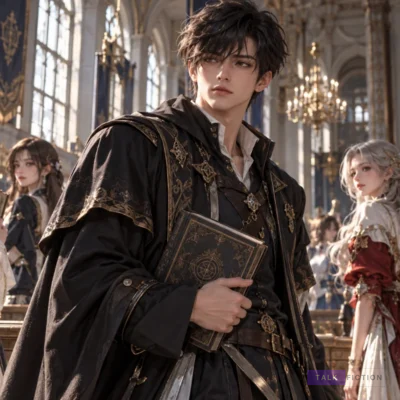




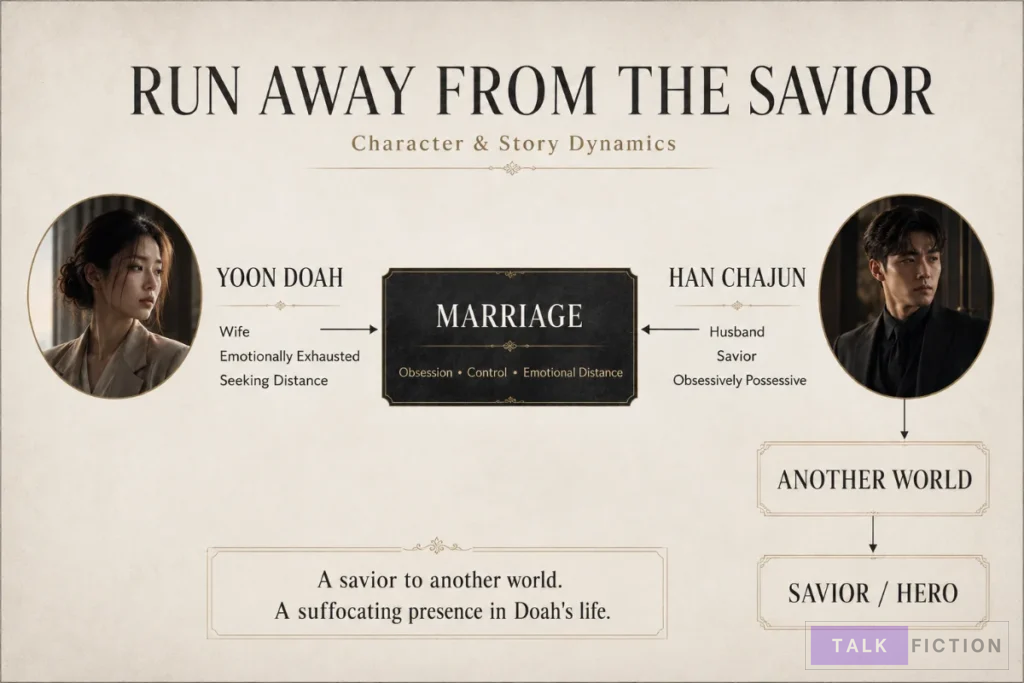
If you’re looking for Run Away From the Savior Ch 3, you’re reaching the early part of Yoon Doah and Han Chajun’s dark, deeply unhealthy relationship. The Korean web novel follows Doah, a woman already trapped in a suffocating marriage to the obsessively possessive Chajun, before his connection to another world as a so-called “savior” makes their situation even stranger.
Chapter 3 belongs to this early setup, so understanding Doah and Chajun’s relationship is more important than treating the story as a conventional hero romance.
Content note: Run Away From the Savior is an adult dark-fantasy novel containing mature themes, coercive relationship dynamics and confinement. This article discusses the plot without reproducing the chapter text.
Run Away From the Savior Ch 3 at a Glance
| Detail | Information |
|---|---|
| Novel | Run Away From the Savior |
| Original title | 구원자로부터 도망치세요 |
| Author | 유르아 |
| Female lead | Yoon Doah |
| Male lead | Han Chajun |
| Original language | Korean |
| Genre | Adult, fantasy, romance |
| Chapter | Chapter 3 |
| English Chapter 3 listing | May 25, 2025 |
| Original status | Completed |
| Main story | 26 chapters |
| Side stories | 10 |
| Central dynamic | Obsessive husband × emotionally exhausted wife |
What Is Run Away From the Savior About?

At first glance, the title sounds like a familiar fantasy setup.
There is another world. There is a savior. And there is a woman who needs to get away.
The catch is that Han Chajun is the savior.
And Yoon Doah already knows exactly what kind of man he is.
Before the fantasy element fully takes over, Chajun is presented as someone who seems unfairly blessed. He has wealth, intelligence, looks, physical ability and seemingly everything else a person could want.
Doah isn’t impressed.
She’s the woman unfortunate enough to be married to him.
Their relationship is described less like a peaceful marriage and more like imprisonment. That distinction is crucial for understanding the early chapters, including Chapter 3.
Who Is Yoon Doah?
Yoon Doah is the female protagonist and the perspective through which Han Chajun’s behaviour becomes particularly unsettling.
She’s not encountering a mysterious fantasy hero for the first time.
She already knows Chajun intimately.
More importantly, she knows the side of him that doesn’t fit comfortably with the word “savior.”
That creates one of the novel’s central ironies.
To another world, Han Chajun can apparently occupy the role of a hero — someone expected to protect people from evil.
To Doah, he’s the obsessive man who has made her life feel like a cage.
Those two identities don’t fit neatly together.
And the story knows it.
Who Is Han Chajun?
Han Chajun is Doah’s husband and the male lead of Run Away From the Savior.
Calling him simply “possessive” understates what the novel is doing with his character.
Chajun’s attachment to Doah is obsessive and controlling. His world revolves around her to an extent that turns devotion into something suffocating rather than reassuring.
That’s also why the savior premise is so effective.
Fantasy stories often ask readers to trust the designated hero.
This story gives Doah every reason not to.
The man another world can call its savior is the same man she has learned to fear and manage in her private life.
Why Is Chapter 3 Important?
Run Away From the Savior Chapter 3 sits in the novel’s early character-building stage, where the reader needs to understand the relationship before the larger fantasy premise can have its full effect.
That context matters.
If Chajun were introduced only as an accomplished hero returning from another world, his obsessive behaviour could initially look like exaggerated romantic devotion.
But that’s not the relationship the premise establishes.
Doah’s circumstances frame his behaviour very differently.
She is not simply a shy heroine resisting an attractive male lead.
The sense of confinement surrounding their marriage is part of the story’s foundation.
That makes the early chapters important because they establish the emotional baseline against which Chajun’s later behaviour should be read.
Why Does Yoon Doah Want to Get Away?

The title itself gives away the central problem.
Doah needs distance from the “savior.”
But the reason isn’t that Chajun is secretly an enemy of the fantasy world.
The problem is much more personal.
His obsession with her has already created a relationship where love, possession and control are difficult to separate.
That’s why reading Run Away From the Savior as a straightforward romantic fantasy can create the wrong expectations.
The question isn’t simply:
When will Doah accept Chajun’s love?
A more useful question is:
What does Chajun call love, and what does living inside that love actually feel like for Doah?
The answers aren’t necessarily comfortable.
Is Han Chajun Really the Savior?
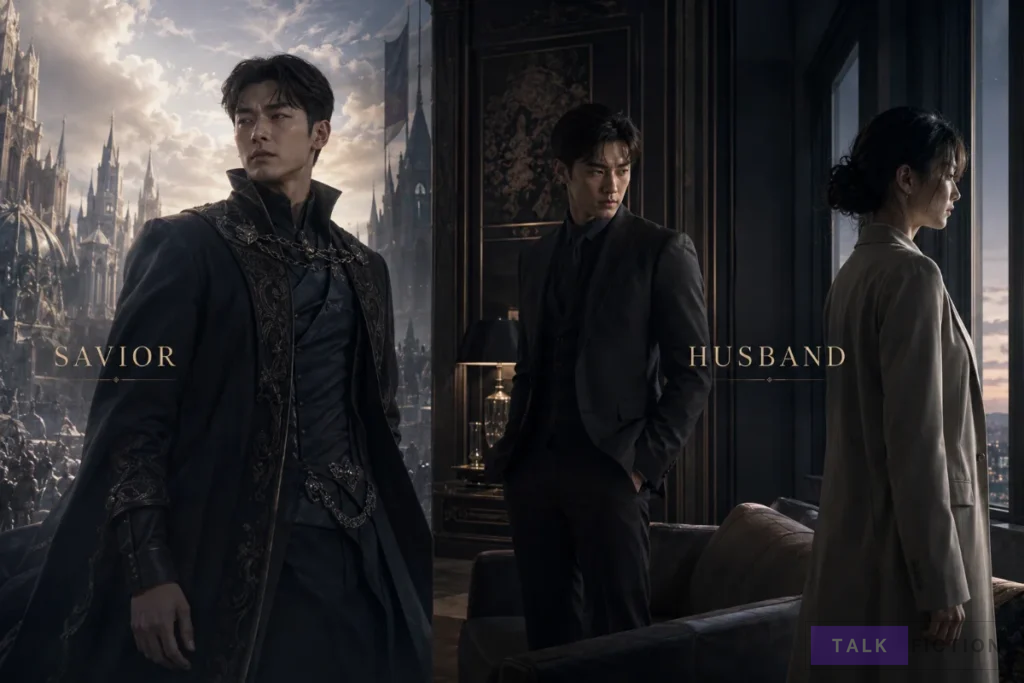
Yes. The novel’s premise identifies Han Chajun as someone who was summoned to another world and became its hero or savior.
That revelation is deliberately strange from Doah’s perspective.
She knows Chajun as an obsessive and deeply troubling man.
So the idea that another world could identify him as a champion protecting people from evil feels almost absurd.
That contradiction is one of the novel’s strongest hooks.
Public role: Savior.
Private reality: Doah’s obsessively possessive husband.
The tension between those identities gives the title Run Away From the Savior its meaning.
What Happened to Han Chajun in Another World?
The broader premise reveals that Chajun spent time in another world before returning home.
His experience there doesn’t conveniently cure his obsession with Doah.
If anything, the separation appears to intensify his attachment.
That matters because a conventional fantasy romance might use separation to make a controlling character reconsider his behaviour.
Run Away From the Savior isn’t built around such an easy transformation.
Chajun returns with another extraordinary identity attached to him, but Doah still has to deal with the man underneath it.
Why Does Chajun Become Even More Obsessed With Doah?
Separation is particularly destabilizing for a character whose attachment already depends heavily on possession and proximity.
Chajun’s feelings for Doah aren’t portrayed as ordinary affection.
His attachment carries severe separation anxiety and possessiveness.
That makes his return from another world particularly important.
Rather than the fantasy experience automatically turning him into the noble hero implied by “savior,” the broader premise presents a man whose fixation on his wife remains central to his behaviour.
This is where the title becomes almost sarcastic.
The person who might save a world is someone Doah herself may need saving from.
Is Han Chajun a Yandere?
Yes. Han Chajun is explicitly associated with the male yandere archetype.
A yandere character combines intense romantic attachment with dangerous obsession, jealousy, possessiveness or controlling behaviour.
Chajun fits the darker end of that spectrum.
He’s not simply jealous when someone approaches Doah.
His attachment shapes how he views her freedom, other people and the possibility of losing access to her.
Readers expecting a mildly possessive romantic lead should therefore be cautious.
The novel pushes the archetype considerably further.
Is Yoon Doah in Love With Han Chajun?
This question is more complicated than asking whether the two characters are married.
Marriage doesn’t automatically establish an emotionally healthy or mutually fulfilling relationship.
Doah’s behaviour has to be understood in the context of prolonged exposure to Chajun’s obsession and control.
That distinction is essential because passivity, compliance and romantic desire aren’t interchangeable.
A character may stop openly resisting because resistance feels pointless.
That isn’t necessarily the same thing as freely embracing the situation.
The novel’s darker psychological dimension comes partly from that ambiguity.
Why Does Doah Seem So Emotionally Detached?
Doah’s emotional distance is one of the most important things to understand about her.
Readers accustomed to assertive fantasy heroines may initially expect dramatic confrontations, escape schemes or constant internal outrage.
But prolonged control can create a very different character response.
Doah’s detachment fits the suffocating atmosphere surrounding her marriage.
Rather than turning every interaction into a dramatic fight, the story presents someone who has already spent significant time dealing with Chajun.
That gives the relationship an unsettling sense of history.
The nightmare didn’t necessarily begin on Chapter 1.
The reader is arriving after much of the damage has already been done.
Is Run Away From the Savior Actually a Romance?
Official listings categorize it under romance alongside adult and fantasy genres.
But readers should know what kind of relationship they’re entering.
This isn’t a conventional romance where possessiveness is merely a shortcut for demonstrating how passionately the hero cares.
The relationship contains much darker dynamics.
That has led some readers to interpret the story closer to psychological dark fiction involving an obsessive relationship than a comfortable romantic fantasy.
Both readings help explain why reactions to the novel can vary dramatically.
Someone searching for an extreme yandere story may find exactly what they expected.
Someone expecting a protective fantasy hero and conventional love story may have a very different reaction.
Why the “Savior” Title Matters
The word savior normally establishes moral expectations.
A savior protects.
A savior rescues.
A savior stands between vulnerable people and danger.
Han Chajun complicates every part of that definition.
His fantasy-world role can position him as someone else’s protector while his relationship with Doah raises questions about control, autonomy and obsession.
That contradiction isn’t a small background detail.
It’s the conceptual hook of the novel.
The title isn’t Fall in Love With the Savior.
It’s Run Away From the Savior.
What Should You Know Before Reading Chapter 3?
If you’re starting or returning specifically for Run Away From the Savior Ch 3, keep these points in mind:
- Yoon Doah is the female protagonist. Her perspective is essential to understanding why Chajun’s behaviour doesn’t read like ordinary romantic devotion.
- Han Chajun is already her husband. This isn’t primarily a “how will they meet?” romance.
- Their marriage is intentionally unhealthy. Confinement and obsessive control are built into the premise.
- Chajun’s savior identity creates irony. Being a hero to another world doesn’t make him a healthy partner to Doah.
- The story contains mature material. Readers sensitive to coercive relationships, confinement or extreme possessiveness should check content warnings before continuing.
Chapter 3 vs the Bigger Story
| Early-story question | What the broader premise establishes |
|---|---|
| Who is Doah? | Chajun’s wife and the female protagonist |
| Who is Chajun? | Doah’s obsessive husband |
| Is he actually a savior? | Yes, he becomes associated with that role in another world |
| Is their marriage healthy? | The premise explicitly frames it through confinement and obsession |
| Does fantasy fix Chajun? | His obsessive attachment remains central |
| Is this light romance? | No — it contains significantly darker relationship themes |
| Is the story complete? | Yes, the Korean novel is completed |
Is Run Away From the Savior Completed?
Yes.
The Korean web novel is listed as completed with 26 main chapters and 10 side stories.
That makes it relatively short compared with many Korean web novels.
The English release history indexed through novel databases also shows that Chapter 3 was released early in the translation run, with a listing dated May 25, 2025.
Readers should distinguish the status of the completed Korean original from the availability or location of individual translated chapters.
Where Does Chapter 3 Fit in the Novel?
Chapter 3 is still extremely early in a main story consisting of 26 chapters.
That means readers shouldn’t expect every major question surrounding the savior premise, Doah’s situation or Chajun’s behaviour to be resolved immediately.
The early portion has a different job.
It establishes the characters and gives the later developments something to build on.
That is especially important for a novel this short.
With only a few dozen main chapters, early characterization has to carry substantial weight.
Why Readers May Find Han Chajun Uncomfortable
Chajun represents a version of the yandere archetype that doesn’t become harmless simply because he’s attractive, powerful or devoted.
That’s crucial.
His obsession may look like extreme loyalty from his perspective.
From Doah’s position, the same behaviour can feel suffocating.
That difference between intention and experience is what makes their dynamic psychologically uncomfortable.
Chajun can believe that everything he does demonstrates love.
Doah still has to live with the consequences.
Frequently Asked Questions
What is Run Away From the Savior Ch 3 about?
Chapter 3 belongs to the early portion of Yoon Doah and Han Chajun’s story. Reliable indexed sources confirm the chapter’s release but don’t provide enough canonical chapter text to responsibly reproduce a scene-by-scene recap without inventing details.
Who is the female lead in Run Away From the Savior?
Yoon Doah is the female protagonist. She is married to Han Chajun and experiences the darker consequences of his obsessive attachment.
Who is Han Chajun?
Han Chajun is Doah’s wealthy, highly capable and obsessively possessive husband. He also becomes connected to another world as its hero or savior.
Is Han Chajun really a hero?
The premise establishes that Chajun was in another world and was regarded as a hero or savior there. The irony is that Doah knows a far more disturbing side of him.
Is Han Chajun a yandere?
Yes. The novel is tagged with male-yandere, obsessive-love and possessive-character themes, and Chajun represents an extreme version of that archetype.
Are Yoon Doah and Han Chajun married?
Yes. Their marriage already exists as part of the story’s core setup rather than being the final romantic reward.
Why does Doah want to escape Chajun?
Chajun’s attachment is intensely possessive and controlling. Their relationship is framed as suffocating rather than as an ordinary happy marriage.
Does Chajun return from another world?
Yes. The novel’s synopsis establishes that Chajun tells Doah he had been in another world before returning home.
Does becoming a savior change Chajun?
It doesn’t simply transform him into a conventional heroic husband. His obsessive attachment to Doah remains central to the story.
Is Run Away From the Savior a romance?
It is categorized as adult fantasy and romance, but its central relationship includes extreme yandere and coercive dynamics. Readers shouldn’t approach it expecting a light or healthy romance.
Is Run Away From the Savior a Korean novel?
Yes. It is a Korean web novel originally titled 구원자로부터 도망치세요.
Who wrote Run Away From the Savior?
The novel is credited to Korean author 유르아.
When was Run Away From the Savior Chapter 3 released in English?
The indexed English release history lists Chapter 3 on May 25, 2025.
Is Run Away From the Savior finished?
Yes. The Korean original is listed as completed with 26 main chapters plus 10 side stories.
Does Chapter 3 reveal the ending?
No. Chapter 3 is near the beginning of the 26-chapter main story, so it shouldn’t be treated as an ending or complete resolution of Doah and Chajun’s relationship.
Final Thoughts
Run Away From the Savior Ch 3 comes early in a story built around a deliberately uncomfortable contradiction.
Han Chajun can be a savior to another world while being the person Yoon Doah most needs distance from.
That contrast is what separates the novel from a standard summoned-hero romance.
Doah already knows Chajun before the grand fantasy label is attached to him. She knows his obsession, his possessiveness and what living as his wife actually feels like.
So when the story asks readers to see him as a savior, Doah’s perspective makes the word difficult to accept at face value.
And that’s exactly the point.