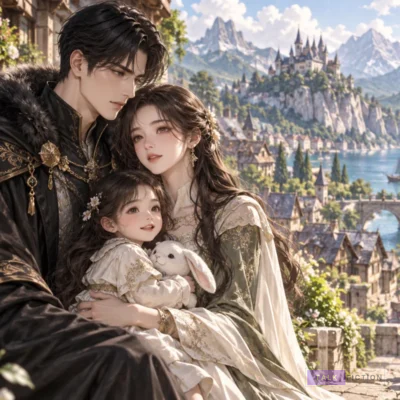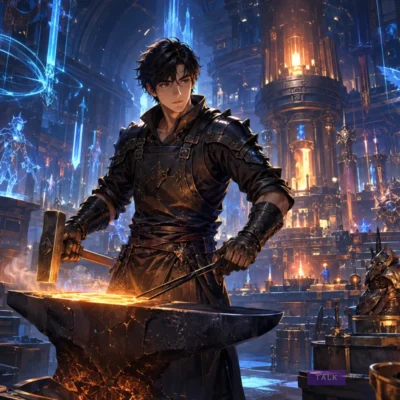




I Became a God in a Horror Game follows Bai Liu, an unemployed man who becomes involved in a dangerous horror livestream game filled with monsters, hostile players, supernatural abilities, and deadly scenarios. What begins as a struggle for survival gradually expands into a much larger story involving powerful characters, the game system, different worldlines, the Evil God, and Bai Liu’s complicated connection to the people around him.
The original Chinese web novel was written by Pot Fish Chili (壶鱼辣椒). It is listed as completed with 589 chapters plus 6 extras. The novel is also known by titles including Embrace You Till the End of the Game, God in a Horror Game, 我在惊悚游戏里封神, and 我在无限游戏里封神.
What Is I Became a God in a Horror Game About?
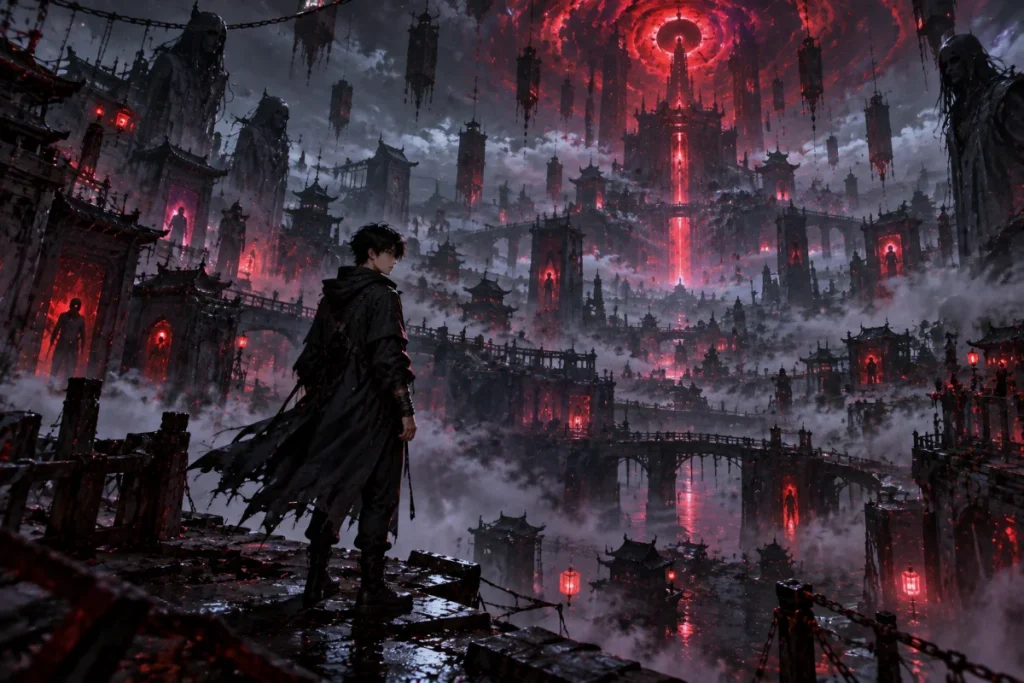
I Became a God in a Horror Game is a Chinese horror-fantasy web novel centered on Bai Liu.
After losing his job, Bai Liu becomes involved with an unstoppable horror livestream game where players must face dangerous monsters, deadly scenarios, and other people who may have their own reasons for killing or manipulating them.
At first, Bai Liu appears to be an ordinary person who has wandered into an extraordinary situation.
That changes quickly.
He discovers that surviving the game requires much more than physical strength. Players have to understand rules, investigate strange environments, recognize hidden dangers, cooperate with others, and make decisions under extreme pressure.
Bai Liu’s ability to analyze situations becomes one of his greatest advantages.
The story then expands beyond individual horror scenarios as Bai Liu discovers that the game is connected to much deeper mysteries involving identities, supernatural forces, and different worldlines.
Who Is Bai Liu?
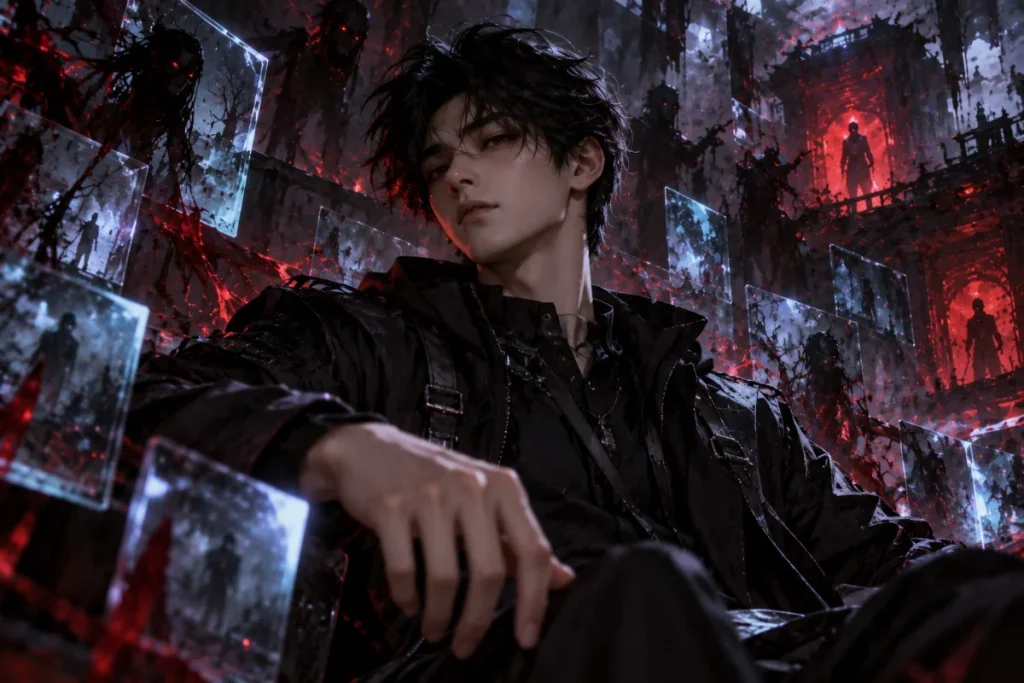
Bai Liu is the protagonist of I Became a God in a Horror Game.
He is intelligent, calculating, and highly adaptable.
Bai Liu is not written as a traditional heroic character who immediately charges toward danger to save everyone.
Instead, he tends to examine a situation before deciding what action gives him the greatest chance of success.
This makes him especially effective inside the horror game.
A monster may appear overwhelmingly powerful, but Bai Liu looks for the rules behind the monster.
A player may appear trustworthy, but Bai Liu considers what that person actually wants.
A seemingly impossible scenario may contain a hidden condition that changes the entire situation.
His ability to identify these details becomes central to his progression.
Why Is Bai Liu So Dangerous?
Bai Liu’s greatest advantage is his ability to understand systems and people.
He does not rely entirely on brute force.
Instead, he frequently combines:
- Observation
- Strategy
- Psychological analysis
- Risk management
- Manipulation
- Teamwork
- Knowledge of game mechanics
- Understanding of supernatural abilities
This makes his victories different from those of a conventional overpowered protagonist.
Bai Liu can win because he understands something that his opponent has failed to notice.
That approach also fits the horror genre particularly well.
Fear becomes less effective when Bai Liu can understand the mechanism creating it.
How Does the Horror Game Work?
The story uses a game structure built around dangerous horror livestream scenarios.
Players enter different game environments and face unique threats.
The scenarios can contain:
- Monsters
- Other players
- Hidden rules
- Special abilities
- Items
- Dangerous environments
- Psychological challenges
- Survival conditions
- Team-based objectives
The rules of one game do not necessarily work the same way in another.
That means players have to investigate their surroundings and understand what kind of challenge they are facing.
This is one reason the novel can move between very different horror environments while maintaining a consistent overall system.
The Horror Livestream Concept
The livestream element gives the game another layer.
Players are not simply fighting monsters in an isolated dungeon.
Their actions exist within a larger game environment where performance, survival, reputation, and supernatural mechanics can all matter.
The audience and game structure add pressure to situations that would already be dangerous without them.
Bai Liu learns how to use this environment instead of simply reacting to it.
Monsters and Game Mechanics
Monsters are an important part of the game’s structure.
They are not simply enemies that exist to provide combat scenes.
Different monsters can have different rules, weaknesses, abilities, and relationships with the game’s mechanics.
Understanding those differences is often essential for survival.
This turns many encounters into puzzles.
The question is not always:
“Can Bai Liu defeat this monster?”
Sometimes the more important question is:
“What are the rules that determine whether this monster can actually be defeated?”
That distinction is central to the series.
Bai Liu’s Skills and Abilities
Bai Liu’s abilities develop as the story progresses, but his most important strength remains his ability to think strategically.
Analytical Thinking
Bai Liu constantly observes details and searches for patterns.
He tries to understand why something is happening before deciding how to respond.
Psychological Manipulation
Bai Liu is capable of influencing other players by understanding what motivates them.
This can be especially powerful in a game where fear and uncertainty make people easier to manipulate.
Adaptability
Every game can introduce different conditions.
Bai Liu therefore needs to adjust his strategy instead of relying on one fixed method.
Team Coordination
Although Bai Liu is highly independent, his journey increasingly involves other important players.
He learns how to use the strengths of different teammates while managing their weaknesses.
Understanding the System
The deeper Bai Liu goes into the game, the more he learns about its underlying mechanics.
This knowledge becomes increasingly important as the story moves from ordinary horror scenarios toward its larger supernatural conflict.
Important Characters
The supporting cast is one of the major strengths of the series.
Bai Liu’s relationships with other characters gradually become much more important than simple temporary alliances.
Xie Ta / Tawil
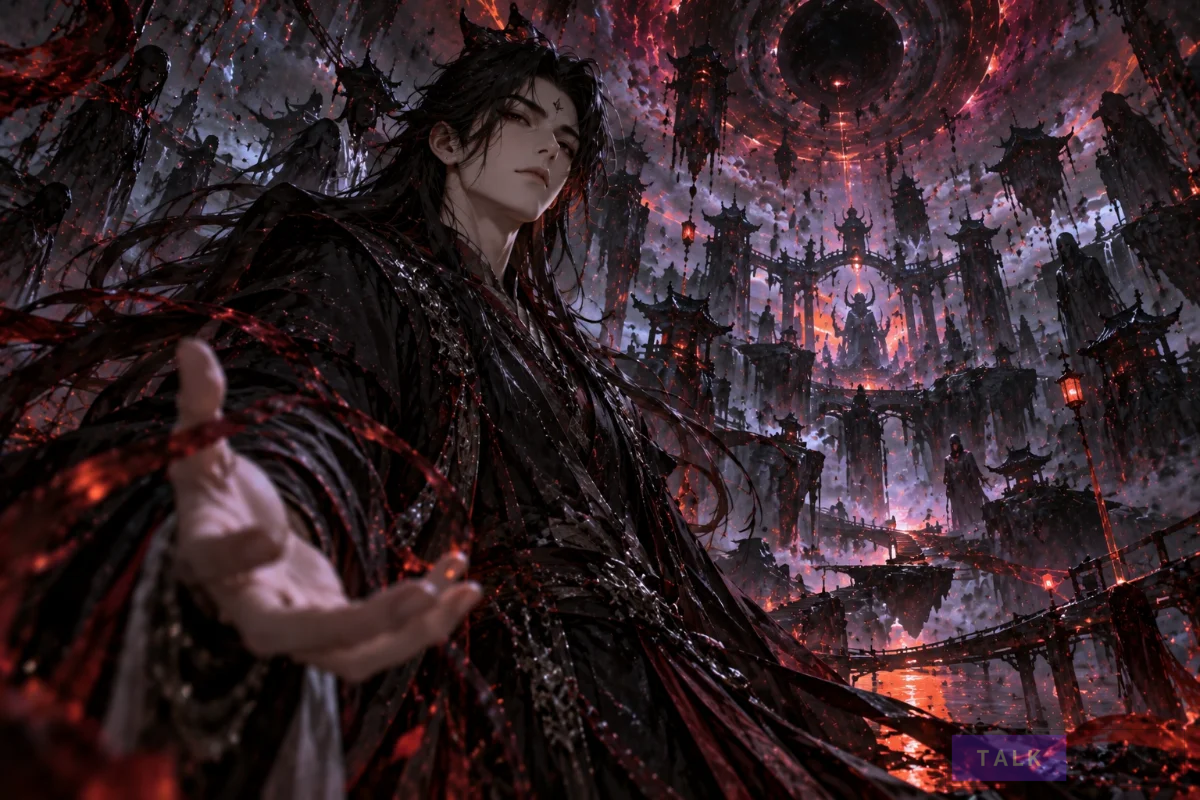
Xie Ta, also known as Tawil, is one of the most important characters connected to Bai Liu.
Their relationship becomes increasingly significant as the story reveals more about their identities and the deeper supernatural structure surrounding the game.
Tawil is associated with the powerful god-level NPC Tawil within the series’ mythology.
The character’s connection to Bai Liu becomes especially important when the novel begins exploring different worldlines and alternate versions of events.
Mu Sicheng
Mu Sicheng is a skilled player who becomes an important member of Bai Liu’s group.
He is associated with a thief-type role and has abilities that complement Bai Liu’s strategic approach.
His relationship with Bai Liu develops over time rather than remaining a simple partnership based on convenience.
Liu Jiayi
Liu Jiayi is another important player connected to Bai Liu’s team.
She is intelligent, cautious, and capable of making difficult decisions.
Her personal history and relationships with other characters also connect to some of the novel’s darker themes.
Mu Ke
Mu Ke becomes another important member of Bai Liu’s circle.
His development is tied closely to his relationship with Bai Liu and the changes he experiences throughout the story.
Tang Erda
Tang Erda is one of the most complicated characters in the novel.
His relationship with Bai Liu begins from a position of intense hostility, but later revelations make their conflict considerably more complicated.
Tang Erda is particularly important for understanding the story’s themes of alternate worldlines, repeated events, memory, and different versions of the same characters.
The Wandering Circus
The Wandering Circus becomes one of the most important groups associated with Bai Liu.
It functions as his guild and brings together several major characters.
The group includes characters such as Bai Liu, Mu Sicheng, Mu Ke, Tang Erda, and others.
What makes the Wandering Circus important is not simply its strength.
Its members have different personalities, motivations, abilities, and histories.
Their relationships give the story an emotional dimension that balances the horror and supernatural elements.
Why the Wandering Circus Matters
The Wandering Circus gradually becomes more than a temporary team.
The members develop trust and loyalty through repeated dangerous situations.
This matters because the horror game constantly creates circumstances where cooperation can become a liability.
Trusting the wrong person can lead to death.
Trusting the right person can completely change the outcome of a game.
Bai Liu’s relationship with his team therefore becomes an important part of his character development.
The Worldline System Explained
The concept of worldlines becomes increasingly important as the novel progresses.
The story does not treat Bai Liu’s reality as completely isolated.
Different versions of events and different versions of characters can exist across different worldlines.
This creates important questions about identity and memory.
If another version of a person exists somewhere else, what makes the current version of that person unique?
And what happens when the experiences of different worldlines begin affecting the current story?
These questions become particularly important to Bai Liu, Tang Erda, Xie Ta, and other major characters.
What Is the Evil God?
The Evil God is one of the major supernatural forces connected to the deeper mythology of the story.
As Bai Liu progresses through the game, the narrative gradually moves beyond ordinary survival horror.
The game becomes connected to larger questions about power, identity, reality, and the forces governing the worldlines.
The Evil God is therefore not simply another monster for Bai Liu to defeat.
Its significance is tied to the larger structure of the game and Bai Liu’s place within that structure.
Is the Horror Game Just a Game?
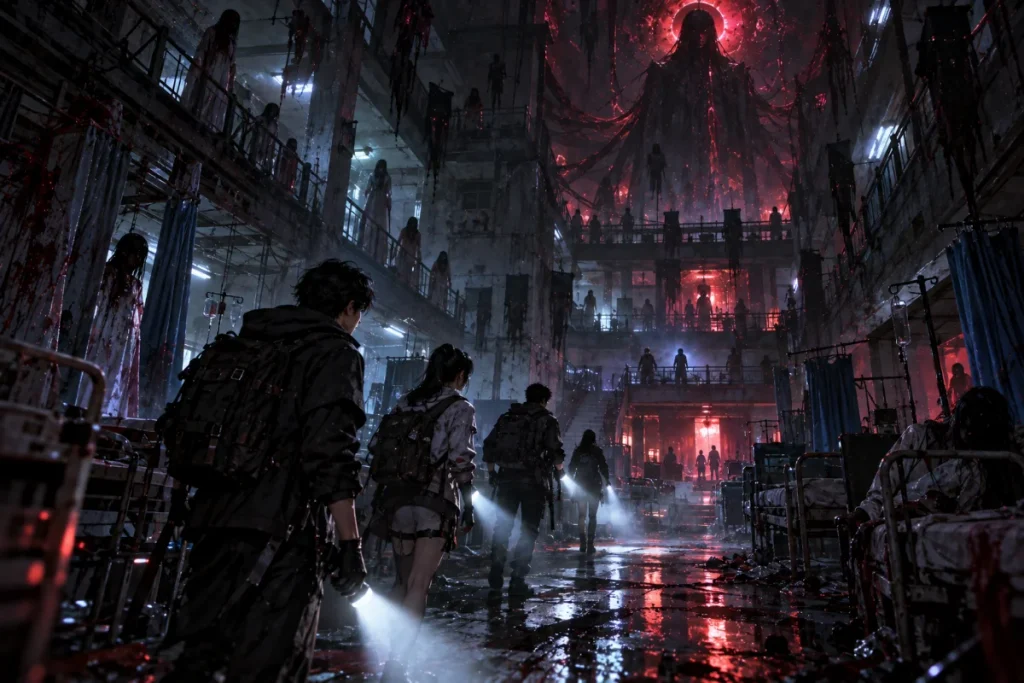
No.
This becomes one of the most important realizations in the story.
The horror game initially appears to be a deadly entertainment system where players compete and survive different scenarios.
As Bai Liu learns more, the distinction between the game and reality becomes increasingly complicated.
The events inside the game can have consequences beyond an individual match.
Characters can have histories that extend beyond the current scenario.
Different versions of characters can become relevant.
And the game itself becomes connected to a much larger supernatural structure.
This is what allows the story to expand from survival horror into a broader fantasy and science-fiction mystery.
The Meaning Behind the Title
The title I Became a God in a Horror Game reflects the direction of Bai Liu’s journey.
However, the story is not simply about gaining increasingly powerful abilities.
Godhood is connected to larger questions involving:
- Power
- Belief
- Identity
- Control
- Influence
- Reality
- Choice
Bai Liu’s progression therefore involves more than becoming stronger.
He gradually discovers what it means to have influence over a system that once controlled him.
Is Bai Liu a Traditional Hero?
Not exactly.
Bai Liu is pragmatic and can be selfish.
Money is one of his recurring motivations, and he is willing to make morally complicated decisions when necessary.
At the same time, his relationships gradually challenge that self-interest.
The people around him become important enough that his choices can no longer be explained simply through personal gain.
This tension between selfishness and attachment is one of the most interesting aspects of his character.
Major Themes in I Became a God in a Horror Game
Fear and Control
The novel explores what happens when people are placed in situations designed to make them afraid.
Bai Liu gradually learns that understanding fear can provide control over it.
Identity
Different worldlines and versions of characters make identity one of the story’s central themes.
Power
The story repeatedly questions whether gaining power actually solves a person’s problems.
Trust
The game environment makes trust dangerous.
Players must decide when to cooperate and when cooperation could become a fatal mistake.
Sacrifice
Many important characters eventually face situations where they must decide what they are willing to lose for someone else.
Human Connection
Despite its horror setting, the story increasingly emphasizes relationships between people.
Those relationships become more important as the supernatural conflict grows.
I Became a God in a Horror Game Novel Status
The original Chinese web novel is completed.
Novel Updates currently lists 589 chapters plus 6 extras and identifies the author as 壶鱼辣椒 (Pot Fish Chili). The original publisher is listed as JJWXC.
The English translation is not listed as completely translated on Novel Updates, so readers should distinguish between the completed original Chinese novel and the availability of translated chapters.
Alternate Titles
Readers may find the series under several different names.
The associated titles include:
- I Became a God in a Horror Game
- Embrace You Till the End of the Game
- God in a Horror Game
- Jingfeng
- 我在惊悚游戏里封神
- 我在无限游戏里封神
- 我在驚悚遊戲裡封神
- 惊封
- 惊悚游戏
These alternate titles are useful when searching for chapters, character discussions, translations, or additional information about the series.
Is There a Manhua Adaptation?
The novel has also received adaptation-related media, including a manhua adaptation.
However, readers should distinguish the original web novel from its adaptations because chapter numbering, release schedules, and presentation can differ.
For Talk Fiction readers interested in similar dark and suspense-focused stories, the site’s Thriller novel collection is also a relevant internal resource.
I Became a God in a Horror Game Ending Explained
Major spoilers below.
The ending brings together the story’s major conflicts involving Bai Liu, the game system, the Evil God, the different worldlines, and the people who have become important to Bai Liu throughout his journey.
The ending should not be reduced to a simple “Bai Liu becomes a god and wins” explanation.
The larger point is what Bai Liu chooses to do with the power and understanding he has gained.
His journey begins with survival.
He enters the game trying to navigate dangerous situations, understand the rules, and obtain the resources necessary to continue.
But the further he progresses, the more he learns that the game is connected to something much larger.
The final conflict therefore operates on several levels.
The Game
Bai Liu confronts the larger structure that has controlled the players and shaped their experiences.
The Worldlines
The story’s different timelines and versions of characters become part of the final resolution.
The Evil God
The supernatural conflict surrounding the Evil God reaches its decisive stage.
Bai Liu’s Choice
Most importantly, Bai Liu has to decide what kind of person he wants to be after obtaining power that goes far beyond ordinary human limitations.
The conclusion therefore focuses not only on victory but also on identity and personal choice.
What Happens to Bai Liu?
Bai Liu’s journey ultimately comes back to the same question that has followed him throughout the story:
What is power worth if it costs him the relationships and identity that give his life meaning?
His development changes him from someone primarily concerned with survival and personal gain into someone who has to make decisions on a much larger scale.
His relationships with the people around him become central to the final resolution.
This gives the ending an emotional dimension that goes beyond the horror-game mechanics.
Why the Ending Is Important
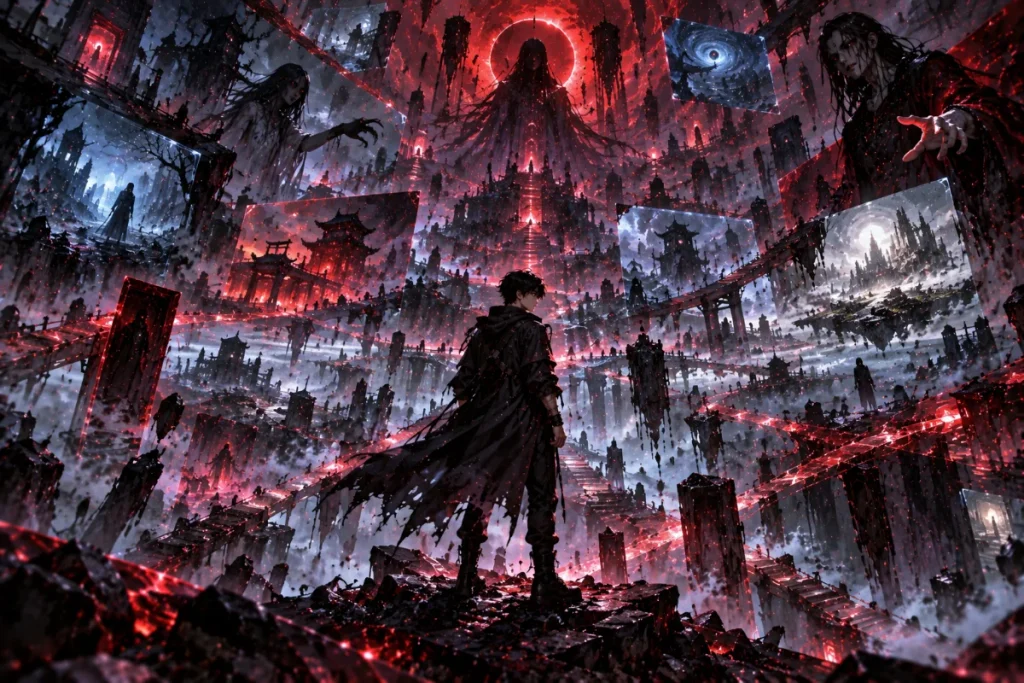
The ending completes Bai Liu’s character development.
At the beginning, he is an unemployed man who becomes involved with a dangerous horror livestream game.
By the end, he is connected to conflicts involving supernatural forces, worldlines, and the fundamental structure of the game itself.
The scale of his journey changes dramatically.
But the story ultimately returns to personal questions:
- Who is Bai Liu?
- What does he value?
- Who does he trust?
- What is he willing to sacrifice?
- What does he want after the game is over?
That is why the ending works as more than a simple power-up conclusion.
Frequently Asked Questions
What is I Became a God in a Horror Game about?
It follows Bai Liu after he becomes involved with a dangerous horror livestream game containing monsters, hostile players, supernatural abilities, and deadly scenarios. The story eventually expands into a larger mystery involving worldlines, the Evil God, and the game’s deeper structure.
Who is the main character in I Became a God in a Horror Game?
The main character is Bai Liu, an intelligent and calculating man who becomes involved in the horror game after losing his job.
Who wrote I Became a God in a Horror Game?
The novel was written by 壶鱼辣椒 (Pot Fish Chili) and was originally published through JJWXC.
Is I Became a God in a Horror Game completed?
Yes. The original Chinese web novel is listed as completed with 589 chapters plus 6 extras.
What is the Chinese title?
The novel is associated with 我在惊悚游戏里封神 and 我在无限游戏里封神, among other alternate titles.
Who is Xie Ta?
Xie Ta, also known as Tawil, is a major character whose connection with Bai Liu becomes increasingly important as the story explores its supernatural mythology and worldlines.
Who is Mu Sicheng?
Mu Sicheng is a skilled player who becomes an important member of Bai Liu’s group. His abilities and relationship with Bai Liu contribute significantly to the team’s development.
Who is Liu Jiayi?
Liu Jiayi is a highly capable player who becomes closely connected to Bai Liu and the larger group of characters surrounding him.
What is the Wandering Circus?
The Wandering Circus is Bai Liu’s guild and becomes one of the most important groups in the story. It brings together several major characters and develops from a functional team into a meaningful group.
What are worldlines in the novel?
Worldlines refer to different versions of reality and events within the story. They become increasingly important when characters encounter alternate versions of themselves or people connected to different versions of the timeline.
Who is the Evil God?
The Evil God is a major supernatural force connected to the deeper mythology of the game and the conflicts surrounding Bai Liu.
Is I Became a God in a Horror Game a horror novel?
Yes. Horror is one of its central genres, alongside action, adventure, psychological, science-fiction, supernatural, and tragedy elements.
Is the English translation complete?
Novel Updates currently lists the original novel as completed but does not list it as completely translated into English.
What makes Bai Liu different from other protagonists?
Bai Liu relies heavily on observation, strategy, psychological analysis, manipulation, and understanding the rules of the game rather than depending only on physical strength.
Final Thoughts
I Became a God in a Horror Game begins with a simple survival premise but gradually develops into a much larger story about identity, fear, power, relationships, and the nature of reality.
Bai Liu is at the center of that transformation.
He enters the horror game as an apparently ordinary man, but his intelligence and ability to understand complicated systems allow him to survive increasingly dangerous situations.
As the story expands, the horror scenarios become only one part of a much larger mystery.
The game, the worldlines, the Evil God, the Wandering Circus, and Bai Liu’s relationships all become interconnected.
That is what gives the series its long-term appeal.
It is not simply a story about a person trying to survive a horror game.
It is a story about what happens when someone learns enough about the game to challenge the system itself—and then has to decide what kind of person he wants to become.

Other Articles
Fated to Be Loved by Villains: Plot, Characters & Ending